Frozen Shoulder Treatment in Washington (WA): Acupuncture, Shoulder Pain Relief, and Non-Surgical Recovery
5 min read
Shoulder pain is one of the most common musculoskeletal complaints, especially among adults with repetitive arm use, poor posture, or long hours of desk work. Many patients searching for “frozen shoulder treatment in Washington” or “how to fix shoulder pain naturally” experience stiffness, pain when lifting the arm, and difficulty sleeping due to shoulder discomfort. Although frozen shoulder is commonly used as a general term for severe shoulder stiffness, many cases are actually related to surrounding muscles, tendons, ligaments, or rotator cuff dysfunction rather than true adhesive capsulitis alone. Because the shoulder is one of the most mobile joints in the body, it is also highly vulnerable to imbalance and overuse injuries. Non-surgical treatments such as acupuncture, PIT (point injection therapy), corrective exercise, and rehabilitation can help improve shoulder mobility, reduce inflammation, and restore long-term function.
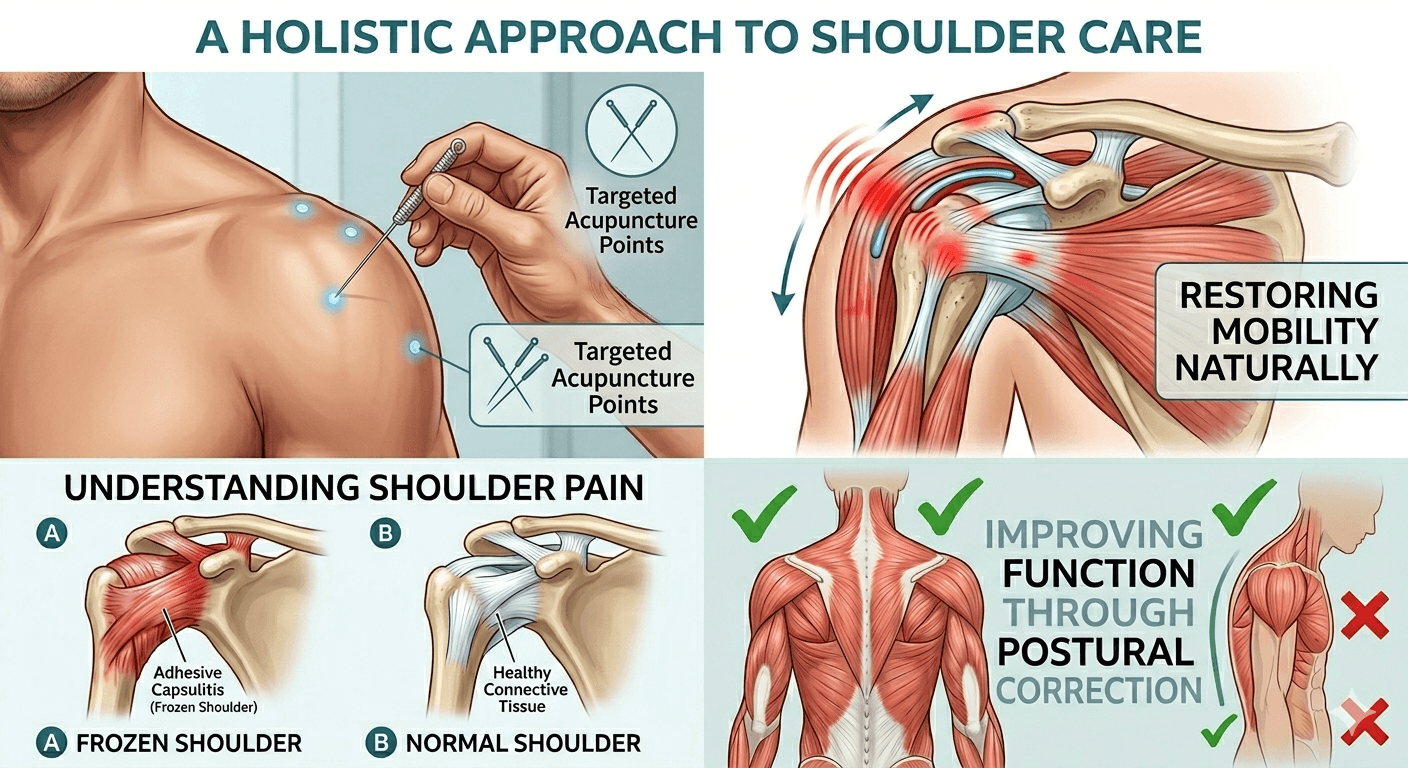
Frozen shoulder is a condition where the shoulder becomes stiff and painful, almost as if the joint has “frozen” in place. Many patients experience severe discomfort when lifting the arm or reaching behind the back, and nighttime shoulder pain is especially common.
Patients searching for:
“why does my shoulder hurt when I lift my arm”
“shoulder pain at night”
“frozen shoulder treatment near me”
are often dealing with this type of condition.
In the strict medical sense, frozen shoulder (adhesive capsulitis) refers to thickening and tightening of the shoulder joint capsule, which limits movement. However, in real clinical practice, true adhesive capsulitis represents only a small percentage of overall shoulder pain cases.
Most shoulder pain actually comes from:
Muscle dysfunction
Tendon injuries
Ligament irritation
Nerve-related pain
Bursa inflammation
Why Is the Shoulder So Easily Injured?
The shoulder is one of the most complex joints in the body.
Unlike the hip joint, which is deeply stabilized by bone structure, the shoulder is supported primarily by:
Muscles
Tendons
Ligaments
This allows the shoulder to move in nearly every direction, but also makes it more vulnerable to injury and imbalance.
The shoulder is connected to many parts of the body, including:
The neck
Upper back and thoracic spine
Ribs
Arms
Because of this interconnected structure, shoulder pain is often influenced by:
Poor posture
Muscle imbalance
Weak core stability
Repetitive movement patterns
Common Conditions That Mimic Frozen Shoulder
Many different shoulder disorders can produce symptoms similar to frozen shoulder.
Common examples include:
Rotator cuff tears
Biceps tendon injuries
Shoulder bursitis
Calcific tendinitis
Shoulder impingement syndrome
Patients searching for:
“rotator cuff pain”
“pain when reaching overhead”
“shoulder tendonitis treatment”
may have one of these conditions instead of true frozen shoulder.
Do You Always Need an MRI for Shoulder Pain?
In many cases, no.
Although MRI imaging can be useful, most shoulder pain cases are initially evaluated through:
Physical examination
Range of motion testing
Orthopedic assessment
Many patients improve significantly with conservative treatment before advanced imaging is needed.
Because MRI studies can be expensive and time-consuming, it is often more practical to begin treatment first and monitor recovery. If symptoms fail to improve or more serious injury is suspected, imaging can then be considered.
This approach is common for patients searching:
“should I get an MRI for shoulder pain”
“when is shoulder pain serious”
Why Posture and Muscle Balance Matter
One of the most overlooked causes of chronic shoulder pain is poor overall body mechanics.
The shoulder does not function independently. Proper shoulder movement depends on balance between:
The neck
Upper back
Core muscles
Shoulder stabilizers
Weakness or imbalance in these areas can gradually change shoulder mechanics and increase stress on tendons and ligaments.
For this reason, long-term shoulder recovery often requires:
Postural correction
Core strengthening
Shoulder stabilization exercises
not just local treatment of the painful area.
Non-Surgical Treatment for Frozen Shoulder and Shoulder Pain
Most shoulder conditions are treated conservatively before surgery is considered.
Common non-surgical treatments include:
Physical therapy
Chiropractic care
Acupuncture
Corrective exercise
Injection therapy
For calcific shoulder conditions, treatments such as:
Shockwave therapy
Targeted injections
may also be used.
Surgery is generally reserved for:
Severe tendon tears
Significant structural damage
Cases that fail conservative treatment
How Acupuncture Helps Frozen Shoulder
Patients searching for “acupuncture for frozen shoulder” or “natural shoulder pain treatment in WA” often want pain relief without surgery or long-term medication use.
Acupuncture can help by:
Improving circulation around the shoulder joint
Reducing inflammation
Relaxing tight muscles
Improving range of motion
One major advantage of acupuncture is that it can improve both:
Pain levels
Shoulder mobility
Research shows that these improvements often remain significant even several months after treatment.
PIT (Point Injection Therapy) for Shoulder Pain
PIT (point injection therapy) may provide even stronger results for some chronic shoulder conditions.
Studies suggest PIT can help improve:
Pain
Shoulder range of motion
Overall shoulder function
with benefits continuing long after treatment.
For patients searching:
“non-surgical frozen shoulder treatment”
“best treatment for chronic shoulder pain”
“shoulder pain treatment in Washington”
PIT may be an effective option alongside acupuncture and rehabilitation.
Shoulder Pain Treatment in Washington (WA)
If you are struggling with frozen shoulder, rotator cuff pain, or chronic shoulder stiffness in Washington, early treatment can help prevent long-term limitation and improve recovery.
Our treatment approach focuses on:
Acupuncture
PIT (point injection therapy)
Herb medicine
Exercise rehabilitation
Postural correction
to help restore shoulder movement naturally and reduce pain without surgery.
References
Korea Institute of Oriental Medicine. Clinical Practice Guidelines for Shoulder Pain in Korean Medicine. Seoul: Elsevier Korea; 2015:126–140, 144–153, 216–218.
Guerra de Hoyos JA, Andrés Martín MDC, Bassas y Baena de Leon E, Vigára Lopez M, Molina López T, Verdugo Morilla FA, González Moreno MJ. Randomized trial of long-term effect of acupuncture for shoulder pain. Pain. 2004;112(3):289–298.
Xiao WX, Xu JJ, Zeng SL. Clinical observation of intensive silver needle acupuncture therapy for frozen shoulder. Journal of Hainan Medical University. 2006;12(6):545–546.
Park YC, Sung WS, Goo BH, Seo BK, Yeom SR, Baek YH. Effectiveness and safety of thread-embedding acupuncture for chronic rotator cuff disease: study protocol for a randomized controlled clinical trial. European Journal of Integrative Medicine. 2019;25:67–76.
Molsberger AF, Schneider T, Gotthardt H, Drabik A. German Randomized Acupuncture Trial for chronic shoulder pain (GRASP): a pragmatic, controlled, patient-blinded, multicenter trial. Pain. 2010;151(1):146–154.
Sun KO, Chan KC, Lo SL, Fong DY. Acupuncture for frozen shoulder. Hong Kong Medical Journal. 2001;7(4):381–391.
Koh PS, Seo BK, Cho NS, Park HS, Park DS, Baek YH. Clinical effectiveness of bee venom acupuncture and physiotherapy in adhesive capsulitis: a randomized controlled trial. Journal of Shoulder and Elbow Surgery. 2013;22(8):1053–1062.
Park YC, Koh PS, Seo BK, Lee JW, Cho NS, Park HS, Park DS, Baek YH. Long-term effectiveness of bee venom acupuncture and physiotherapy in adhesive capsulitis: one-year follow-up analysis. Journal of Alternative and Complementary Medicine. 2014;20(12):919–924.